4K // LIVE
About us // The first real-life Robogames

Robots, competing for real.

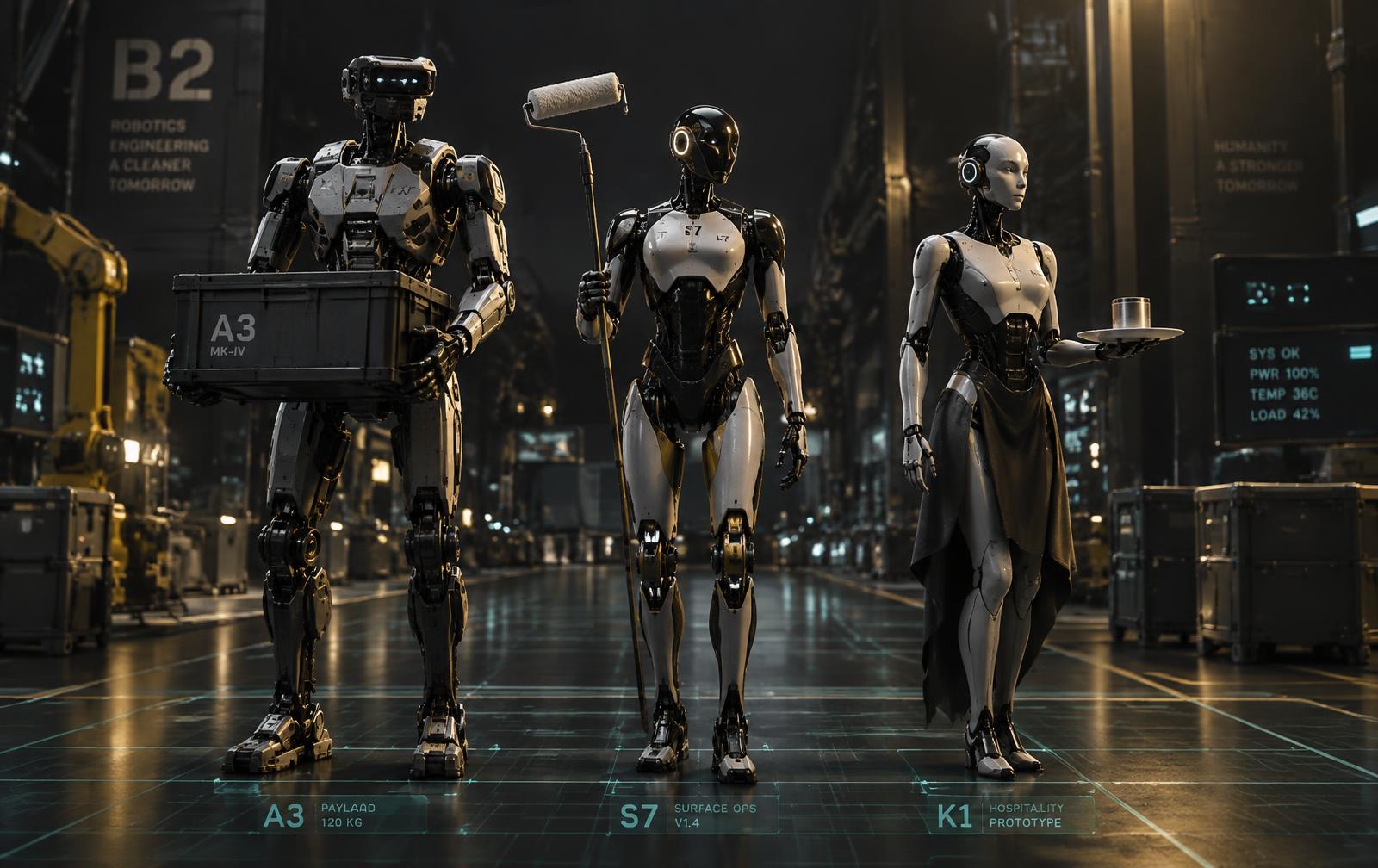
Three different competition robots holding everyday tools in a dark engineering hall
MISSION FEED // WHY WE RACE

We are building the world's first international real-life Robogames — a live world championship where robots do the work of an ordinary human day, in front of an audience, with nothing hidden and nothing edited. This page explains what we are building, why, and how you can be part of it as a competitor, a partner or a spectator.

CAM 01

32 robot teams

CAM 02

7 everyday competitions

CAM 03

$1,000,000 cash prize

Our story // In plain language

A scoreboard the whole industry can trust.

01 //

What we are building

The first international real-life Robogames: a live, ticketed world championship where robots compete at the ordinary work of a human home and a human street — not in a lab, not in a simulator, but in a sealed arena in front of a paying crowd and a global broadcast audience.

02 //

Why it matters

Robotics demos are filmed, edited and repeated until they look perfect. Sport cannot be edited. By putting every robot on the same clock, in the same arena, under the same rules, The P.AI Games creates the first honest public scoreboard for physical AI — and a benchmark the whole industry can be measured against.

03 //

How a robot wins

Seven competitions over two days, scored by an autonomous AI referee using LiDAR, high-speed optics and millisecond timing. Points reward accuracy, care and speed. Declared teleoperation is allowed in the inaugural Games and receives a scoring deduction after the run; undisclosed human input remains a violation. Teams keep 100% of their intellectual property.

04 //

Who it is for

Research labs, universities, robotics companies, startups, independent builders and mixed consortia ready to put a machine on a common benchmark. Teams may compete on third-party robot platforms; they do not need to manufacture the robot. Humanoids, arm-plus-AMR systems and other safe mobile manipulators are welcome.

Robots lined up before competition in a cybernetic hall
The promise // May 18–19, 2027

Two days that set the benchmark.

Seven competitions, one arena, an autonomous AI referee and a live crowd. Every run is timed to the millisecond, filmed at 1,000 frames per second, and scored in public — so the results mean something long after the lights go down.

VISUAL FEED 01

Tel Aviv host city

VISUAL FEED 02

Live global broadcast

VISUAL FEED 03

Teams keep 100% of their IP

Road to the grid // Milestones

How we get to lights out.

2026

Entries open

Team registration, technical scrutineering standards published, early-bird spectator waiting list opens at US$89.

MAR 2027

Grid confirmed

32 qualified robot teams announced with their declared platforms and chosen competitions.

MAY 17 2027

Scrutineering day

Mass inspection, radio clearance, dual-channel emergency-stop validation and battery containment audit.

MAY 18–19 2027

The championship

Two days, seven competitions, one live arena in Tel Aviv, US$1,000,000 in total cash prizes.

Choose your place in the story

If your research team can make a robot perform under pressure, enter the grid — even when the platform comes from a third-party manufacturer. Humanoids, arm-plus-AMR systems and other safe mobile manipulators are welcome. If you want to watch history, join the early-bird waiting list and lock the launch ticket price of US$89 — no payment today.