
4K // LIVE
The show // What your ticket gets you

A sport you can actually read.

Mobile-manipulation robot frozen mid-action under high-speed broadcast cameras in the P.AI Games arena
BROADCAST OPENING FEED

From your seat you watch 1,000-frames-per-second replays of every slip and save on 360° screens, live grip force and joint temperature as the robot works, and an autonomous AI referee scoring each run with no human bias. Two days, seven competitions including an unseen SLAM trail, a live global broadcast — and a crowd that knows exactly when a robot is about to fail. Early-bird tickets are US$89 for both days.

CAM 01

PHANTOM CAMERAS

CAM 02

JOINT VECTOR TRACE

CAM 03

SLOW-MO IMPACT

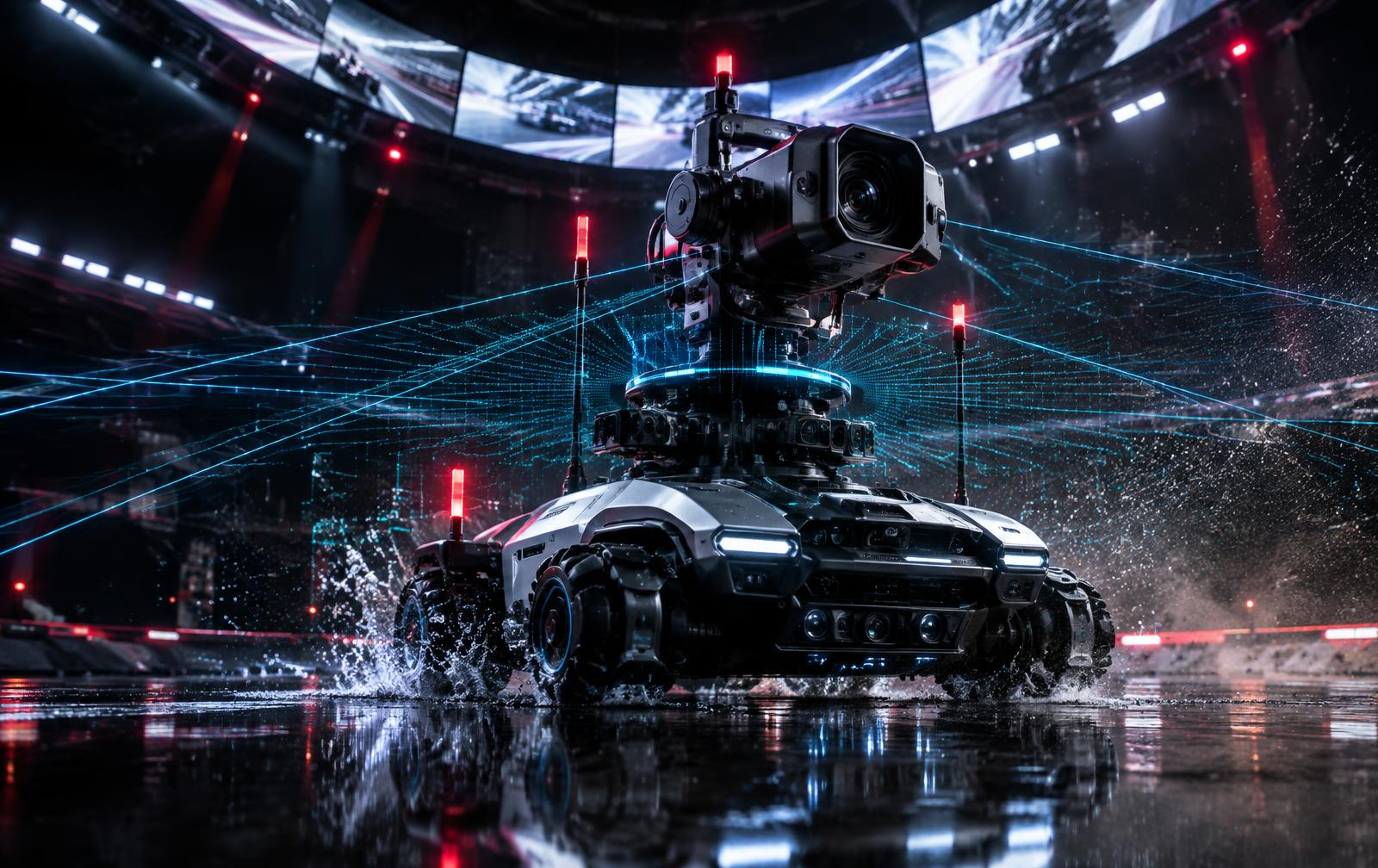
Distinct sensor-heavy broadcast robot in the P.AI Games arena under high-speed cameras
Broadcast visual feed // 1,000 FPS volume

The robot becomes the camera system.

The broadcast page now shifts to a sensor-heavy autonomous platform inside a wet arena volume, surrounded by cyan LiDAR planes, red live beacons, and overhead race screens.

VISUAL FEED 01

4K HDR CAPTURE

VISUAL FEED 02

LIDAR REFEREE MESH

VISUAL FEED 03

360° JUMBOTRONS

Production mesh // 4K HDR

Broadcast-grade instrumentation.

Every arena is captured as a synchronized forensic volume, combining high-speed imaging, calibrated audio, LiDAR, telemetry feeds, and public overlays.

BCAST 01

Phantom high-speed capture

1,000 fps // 4K HDR

Critical slip, fracture, over-torque, and recovery moments are captured from protected race apertures for broadcast replay and scoring audit.

  • Synchronized global shutter timing
  • Failure-window automatic clipping
  • Color-calibrated slow-motion replay
BCAST 02

Joint telemetry theater

Torque // thermal // latency

Arena-wide torque, motor thermal load, gripper pressure, and neural decision latency appear as live data layers above the course.

  • 360-degree overhead jumbotrons
  • Per-joint thermal heat bands
  • Neural latency split overlays
BCAST 03

Autonomous AI Referee

Zero human referee bias

A multi-angle LiDAR grid and optical timing mesh enforce foul detection and millisecond timing without subjective calls.

  • Algorithmic boundary enforcement
  • Contact-event time stamping
  • Post-run audit trail
BCAST 04

Slow-motion stewarding

Replay tribunal

Every red-flag event can be reconstructed from synchronized telemetry, optical flow, and audio impulse data for transparent rulings.

  • Audio impulse classification
  • Object trajectory reconstruction
  • Public penalty ledger

High-speed failure cinema.

Phantom camera arrays record slip onset, fingertip shear, glass vibration, cable sway, fastener cam-out, bag film stress, and stack collapse at 1,000 fps in 4K HDR. Broadcast producers can cut from live race mode into forensic slow motion without breaking the scoring chain.

Telemetry as spectator language.

Joint torque, motor thermal load, power draw, neural decision latency, gripper force, and recovery events are projected on 360-degree overhead jumbotrons so the crowd can read risk and excellence in real time.

Autonomous AI Referee // Millisecond governance

Zero human referee bias.

The referee stack treats every arena as a measured volume. Human stewards supervise safety, but scoring evidence comes from synchronized machine perception.

LiDAR grid

Multi-angle ranging tracks end effectors, object boundaries, forbidden zones, and arena crossings.

Millisecond timekeeping

Start, contact, release, threshold breach, and finish events are stamped by synchronized race clocks.

Algorithmic foul detection

Contact with terminals, glass, spectators' enclosure, or restricted structures triggers automated review.

Transparent appeals

Teams receive replay packets with telemetry, camera frame references, and penalty explanations.